


At the end of World War II, the United States military hastily organized schools for the children of service members who remained stationed in Europe and Asia. At first, each branch managed its own set. Eventually, they were consolidated into a single entity. In 1994, the overseas schools were joined with an existing network of domestic schools for the children of service members (on army bases, etc.) and the Department of Defense Education Activity (DoDEA) was born.
Why am I telling you this? In the past decade, these DoDEA schools have become our nation’s best. They are clobbering the competition - particularly when it comes to less privileged students.
Forget Massachusetts. Forget Mississippi. When it comes to #1, the race isn’t close.
Never heard of DoDEA? You aren’t alone. Let’s get you up to speed and consider why we should be paying more attention to the weirdest - and most successful - American schools.
DoDEA consists of 161 schools serving 67,000 K-12 students belonging to active duty military or civilian Department of Defense families. The schools are spread across the U.S. (31 percent), Asia (29 percent) and Europe (40 percent).1
Though DoDEA schools are staffed by civilians, they exist within the military chain of command, reporting to the Secretary of Defense rather than the Secretary of Education.2
Now, about this wild claim that DoDEA has the best schools in the country: Who says so?
The National Assessment of Educational Progress (NAEP) says so, that’s who. DoDEA has the highest score on each of the tests whose results are reported at the state level: 4th and 8th grade math and reading.3
That’s a good start. But longtime readers know that NAEP averages are not always the best indicator of system quality.4 Details matter. And it’s in the details where DoDEA truly rules.
Here are four ways DoDEA is the top academic dog:
#1. DoDEA Is Depression-proof
We’ve discussed at length the decline in U.S. student achievement that began around 2013. Somehow, this education depression skipped DoDEA schools, like they resided in a parallel dimension.
In 2013, DoDEA was barely among the top states for 8th grade math, snarled in a four-way tie for 10th place with Washington, Colorado, and Pennsylvania.
As the graph below shows, the other top states then dropped precipitously. DoDEA, on the other hand, held steady. As a result, it now holds a lead of nearly a grade level over its nearest competitor, Massachusetts.5 This is remarkable - both DoDEA’s deviation from national trends and the gap it has created with the rest of the pack.
I’m very curious about this part. DoDEA has been around for decades, doing roughly the same work, but it has not always been a top performer. Something made it get hot just when the rest of the country went cold. Put a pin in that - we’ll come back to it.
#2. DoDEA Nails Fundamentals
The key driver of lagging national achievement has been our lowest-performing students. Today’s strugglers are struggling far more than their peers of yesteryear.
The graph below is similar to the one above, but it focuses on students at the 10th percentile of the score distribution for each state. These are the strongest states on this measure as of 2013. DoDEA was already sitting pretty in second place.
Since 2013, however, as the rest of the country has seen 10th percentile scores fall by one or two grade levels, DoDEA has dipped only slightly. The current 14-point gap between DoDEA and North Dakota is enormous - and remember, North Dakota is the second-best state.
The DoDEA performance floor is much higher than anywhere else. Example: Eighty-one percent of DoDEA’s 8th graders score at least Basic on NAEP math, which is a good shorthand for being able to solve rudimentary problems. In New Mexico, the figure is 42 percent. That’s how you set a floor.
#3. DoDEA Delivers Old School Equity
Some states that regularly top NAEP rankings - say, New Jersey and New Hampshire - tend to coast on demographics. They have substantial affluence and small minority populations. Their white students from relatively privileged backgrounds score quite well - and there are enough such students to ensure the state’s overall average is among the best.6
DoDEA is the opposite.
Let’s talk 4th grade reading for a moment, since it is so critical for students to master literacy during the elementary years. Results for DoDEA White and Asian students in 4th grade reading are good but not singular. For those groups, it ranks 2nd and 7th, respectively. Nice.
When it comes to Black 4th graders, though, DoDEA is playing a different game altogether. Check out the graph below. Sixty-seven percent of DoDEA Black 4th graders score Basic or higher on NAEP. The runner-up, New Jersey, is at 53 percent. States like Maine, Wisconsin, and California don’t even crack 30 percent.7
The same is true of Latino 4th graders. DoDEA laps the field, with Mississippi trailing by 15 percent in second place. In Oregon, a Latino 4th grader is less than half as likely to score Basic on NAEP as a DoDEA Latino 4th grader.
To my knowledge, these figures are unprecedented. No school system has so dramatically outperformed all others when it comes to the minority students who have often been the focal point of our education improvement efforts. This is the very best kind of thumping - one based on kids learning lots more.
#4. DoDEA Ensures Demographics Are Not Destiny
Students with more educated parents do better in school. Makes sense. And we’ve all read a zillion headlines about how adolescents don’t read anymore and only consume the equivalent of algorithmic video Pez candies. We’re helpless.
DoDEA did not get that memo. Its schools are very, very good at teaching reading to children with less educated parents.
The plot below maps average NAEP reading scores for 8th graders whose parents graduated college vs those who did not (i.e. did not finish HS, graduated HS, some education after HS).
As expected, states like Massachusetts and New Jersey shine with the children of college graduates. Mississippi does better, comparatively, with the children of non-grads.
DoDEA cleans up with both groups. They are such an outlier that they almost seem lonely there in the upper right. The average DoDEA 8th grader whose parents did not graduate college is about 2.5 grade levels ahead of peers in the next-closest states, Indiana and Massachusetts.
But that’s not the wildest part. Look more closely. Children of non-college graduates in DoDEA schools score as high (279) as children of college grads in Massachusetts and New Jersey.
(This is the part where I drop the mic and attempt to skulk away, only to trip and concuss myself.)
Any Reasons to Be Cautious in Hero-Worshipping DoDEA?
Sure - you know there are.
DoDEA schools are nothing like typical American public schools. All the kids have at least one employed parent, for a start. Their schooling is delivered by that parent’s boss, in essence. Military bases are highly secure, organized, purposeful settings. Relatively few DoDEA students qualify as low income.
I would add that the demographics of DoDEA families have shifted in recent years to the point that 70 percent of students report that their parent(s) graduated college. While DoDEA does a wonderful job with the kids of non-grads, as we just saw, we’re talking about highly educated school communities. Only 45 percent of California students, for instance, have parents who graduated college.
For these reasons and more, we should not rush to anoint DoDEA as “what works” and attempt to carbon copy it in communities across America. With that caveat, let’s get the to the question you’ve probably been asking already…
What Makes DoDEA So Successful?
Let’s start with what DoDEA doesn’t do. No matter your priors, it will confound them.
Conservatives will be annoyed to hear that DoDEA Education Savings Accounts (ESAs) and vouchers played no role because they don’t exist. Likewise, there are no charter schools. DoDEA did not ban or break its teachers union, the Federal Education Association.
It may chafe progressives to learn that DoDEA did not eschew standardized tests or adopt restorative justice discipline models or make every location a community school.
Instead, DoDEA’s transformation began in 2014 when it hired a former Army officer and district superintendent named Tom Brady as its Director.8 He was an odd selection. At the time, the sun was setting on the classic era of education reform. Common Core had become a political piñata. Testing and accountability were going out of style. No Child Left Behind would soon be replaced. The Broad Superintendents Academy, which had trained Brady, was increasingly controversial.
Brady proceeded to ignore all of this. He inherited a DoDEA system divided into three autonomous regions - Europe, Asia, and the Americas - each with its own curricula. His first order of business was to create a “One DoDEA” vision that integrated the regions to achieve greater instructional coherence. Students who moved due to a parent transfer, which is ubiquitous in military life, would find their new schools covering virtually the same material as their old one.
Next, Brady unreservedly embraced a lightly rebranded version of Common Core called “College and Career Ready Standards” and deliberately rolled them out, one subject at a time, over the course of several years.
The whole thing was run with military precision. Lacking an elected school board and small town politics, DoDEA zigged when the rest of the country zagged. Instead of devolving decision-making and reducing its emphasis on measurable learning, as many states did during the 2010s, it placed a bet on treating its far-flung system like an urban district reform project.9 And that bet paid off, big time. When Brady retired in 2024, he’d piloted DoDEA to the top position on every NAEP test.10
This is the provocation of the DoDEA story. It represents a path not taken. While facing the same realities as other systems this past decade - rising teen use of social media and screens, adolescent mental health crises, COVID disruptions - its performance did not suffer in the same way.
It’s tempting to look at DoDEA and shrug. Different kids. Different context. Different world.
But that reaction - that dismissive lack of curiosity - speaks volumes. It shows how we’ve accepted a narrative that declining student learning was unavoidable, that we couldn’t have done any better given the hand we were dealt.
DoDEA did do better, though. It’s putting up some of the best numbers in the history of American education. Now that we know that, it’s awfully hard to un-know it. It’s hard not to wonder whether we made some regrettable calls.
At the least, DoDEA’s dominance is an invitation to reflect honestly. Let’s take it. Let’s learn more about how DoDEA improved instruction in its schools and ask what’s transferable. If we miss such opportunities, we could be stuck in this rotten depression for another decade. Who wants to risk that?
Personal Postscript
In 1965, my great aunt, Beth Daly, joined DoDEA as an English teacher in Bermuda. After stints in the Azores and Kaiserslautern, Germany, she returned to the states in the late 70s to complete a master’s degree. In 1982, Beth rejoined DoDEA as a reading specialist in Gelnhausen, Germany, staying until her retirement in the late 90s.
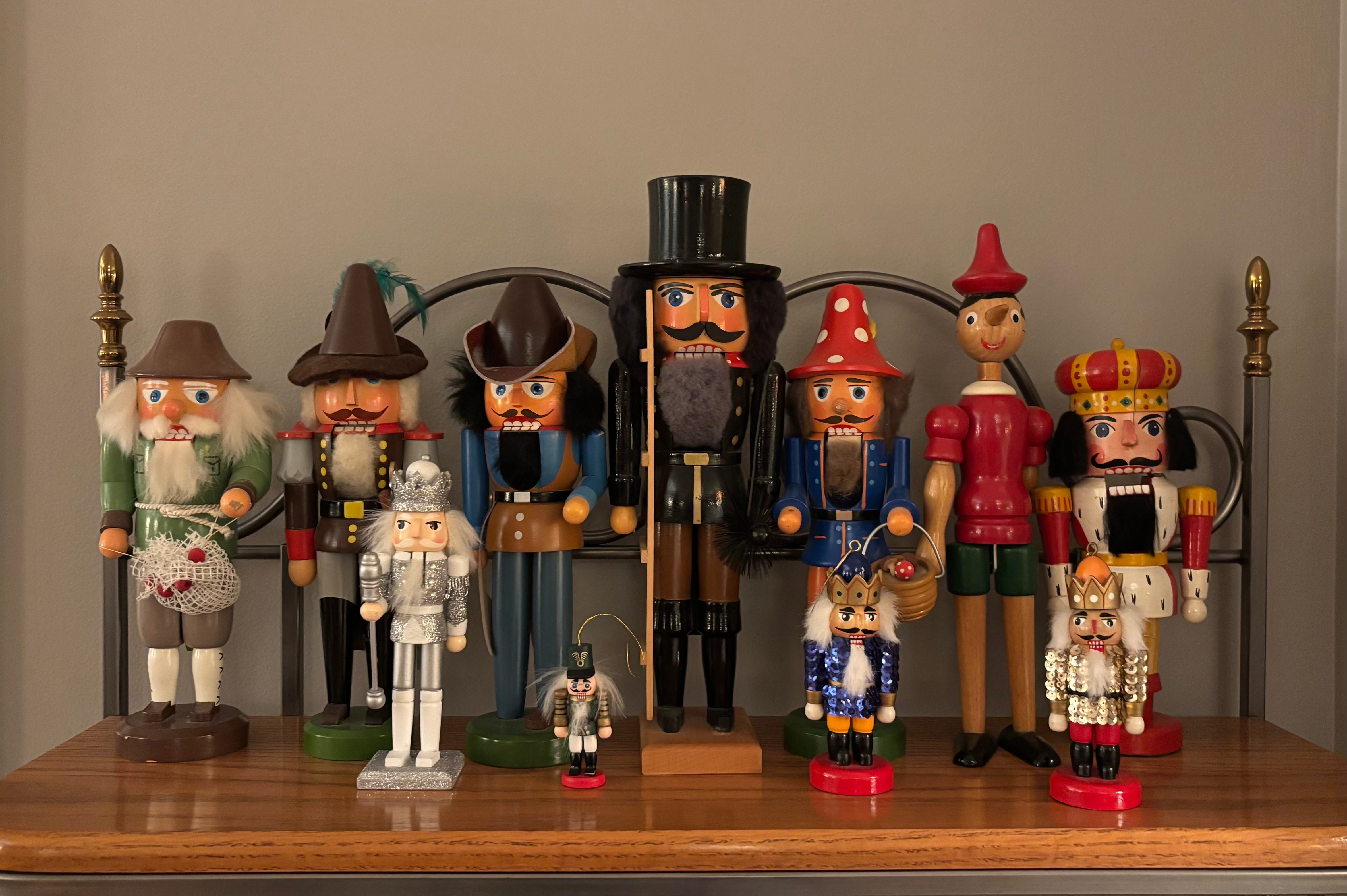
Every year, she sent nutcrackers from the local Christmas market to my brother and me. To this day, mine decorate our living room each December - see below. During study abroad in college, I joined Beth and her teacher friends for a holiday trip to Izmir, Turkey, where we spent New Year’s Eve at an Air Force base party.
My family is extremely proud of Beth’s service and dedication. And we miss her - she passed away in 2008. She would be awfully pleased to see DoDEA’s current results. If you have DoDEA educators in your family, don’t forget to tell them how much their work means.
There is just one other school system directly run by the federal government: the Bureau of Indian Education (BIE). It is administered by the Department of the Interior. A topic for another day.
Throughout, I’ll to refer to DoDEA as a “state” even though it obviously isn’t one. NAEP counts it as a state in its jurisdictional taxonomy - same as the District of Columbia or Puerto Rico.
For my data wonks - I see you! - below are graphs of DoDEA’s 4th and 8th grade NAEP performance vs national averages since 2013. The nation has declined on all four tests while DoDEA has improved on all four. DoDEA’s gains in 8th grade reading may be its greatest achievement relative to the brutal national trend.
10 scale points on NAEP is roughly equivalent to one grade level
If you are curious about these patterns, I strongly recommend perusing the demographically-adjusted NAEP rankings Matt Chingos and Kristin Blagg calculated for the Urban Institute.
If you don’t see a state listed here, it does not meet the reporting requirements for breaking out Black students as a subgroup. Same thing applies to the subsequent graph on Latino 4th graders, though it’s a different set of states missing.
I’m oversimplifying for brevity. Kenneth Wong did an excellent deep dive on DoDEA for Brookings in 2024. Give it a read for more detail. Also, Sarah Mervosh had a well-reported 2023 piece for the Times you’ll want to check out.
If you want examples of states that prioritized local autonomy and decreased focus on standardized tests, take your pick: California, Colorado, New Hampshire, Texas, Vermont. There are plenty more.
Brady’s successor, Beth Schiavino-Narvaez, previously served as his Chief Academic Officer. The first NAEP results from her tenure will likely be released in early 2027. They will be closely watched.
Terrific piece, Tim. When I was writing my book about Success Academy, I noted the observably disproportionate share of children there whose parents were married, employed, and religious. I came across research from William Jeynes who told me, “Family factors are even more important than school factors in terms of determining achievement. That’s just a reality." Jeynes metastudies demonstrated "that in religious (mostly Christian) schools the achievement gap 'mostly goes away' among African American and Latino students 'who are religious and from intact families.'"
Could that explain at least part of what's going on here? If Grok/AI is correct:
Approximately 85-90% of children in DoDEA (Department of Defense Education Activity) schools come from two-parent families, compared to about 70% of U.S. children overall.
Approximately 40-45% of active-duty military personnel attend religious services weekly, compared to about 20-25% of U.S. adults overall who report weekly attendance.
As a curriculum and instruction guy, I'd like the difference to be those things, not family-related. But like the song says, you can't always get what you want. What do you think?
Best,
Robert
Unifying the instructional materials certainly helped increase achievement, but I wonder how much school culture/military culture influenced outcomes. This is of course difficult to measure, but from a purely anecdotal perspective, I have a brother in the military, and having met military families from different socioeconomic backgrounds, I can say with confidence that they all teach their kids to respect authority figures. I will admit that I have a limited perspective because I've never worked at a DoDEA school, but hopefully someone who has worked at one can speak to how military culture (discipline, respect, authority) influences the school environment.