

Time to wrap up 2025. I started the year saying that nobody really knows what’s going to happen in any given year. At least for me, that was true again.
I knew the Trump administration had big plans to change the federal role in education. I did not anticipate that it would sunset most of the civil rights monitoring and enforcement that dates to the Great Society era.
We’re in a new paradigm where states will decide nearly everything for themselves, including whether they need to improve their schools. For now, the feds will focus on keeping score via NAEP and placing spending decisions in the hands of families. More will unfold in 2026. As usual, I haven’t a clue where we will land.
But education is really about hope - hope for our kids, hope for our communities. Schools manufacture hope in tiny daily increments, like stacking up Lego bricks. I remain hopeful that the building happening in so many places will pay off. It’s what motivates me to read a lot of articles and research and bother you about it.
I’m deeply grateful to everyone for reading The Education Daly. I have a ball talking to smart folks as I’m writing these pieces and just as much fun fielding outreach and outrage when they go live. Thank you.
Now, to answer a question nobody asked, here are this year’s five most popular posts (based on views) along with a few updates:
#5:

A decade of dismal education outcomes has seeded a strange and surprising nostalgia for No Child Left Behind, which Matt Barnum recently explored. Its 2015 replacement, the Every Student Succeeds Act, is now seen as a massive failure.
NCLB haters can relax. The future of school accountability is unlikely to look like the past - especially with the Department of Education holding yard sales where cubicles are priced three for $20. On the other hand, there is an unmistakable new public appetite for academic fundamentals. Politicians would be wise to read the room.
#4:

Once upon a time, education was a top domestic policy issue. Those days are long gone, but system leaders continue to proceed as if spending can grow in perpetuity… even if enrollment, attendance, and achievement free fall.
That’s a risky bet. With the recent passage of a federal tax-credit scholarship program and Democratic governors realizing they probably have no choice but to opt-in, big shifts are possible.
#3:

Whoa daddy, this was bad news. Over the course of 2025, there was a whiplash narrative shift from “when will student learning recover from the pandemic?” to “what the hell has been going on since 2013?” That shift kicked into high gear on Jan. 29 with the release of the most depressing test data in our history.
The saddest part was the long term consequences for kids. The second saddest part was the widespread lack of ownership and honesty from state leaders, most of whom cherry-picked silver linings and ignored the big picture.
Journalists took notice. We got some outstanding reporting this year questioning the pattern of complacency.
#2:

I’m shocked and happy to see this one in second place. There’s a tendency to blame our challenges with attention, focus, mental health - even attendance - on screens and phones. But how, on a practical level, does technology contribute to negative outcomes?
A key element is the disruption of sleep. Kids go to bed later, sleep with their devices in-hand, wake up constantly, and arrive at school feeling like they’ve been partying with Mötley Crüe. As Mike Goldstein says, teens cannot flourish until we reset what happens from 3pm to 3am.
#1:
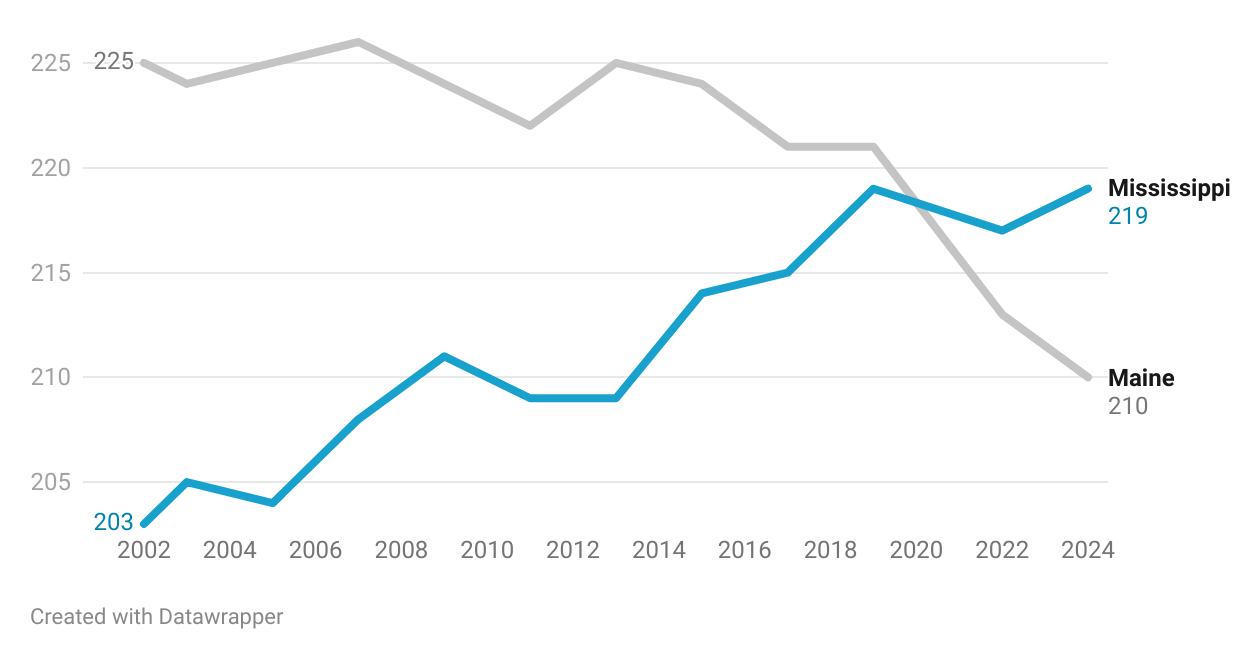
The runaway winner. This piece received 3x as many views as anything else I wrote. Bari Weiss cross-posted it on The Free Press and by the commutative law of addition, I think I own a substantial chunk of CBS News - we’re checking with the lawyers now.
Why was it so popular? People love to argue about Mississippi. Boy, do they. Some folks did amazing work documenting the Southern Surge and the causes behind it. Others shattered word count records and laws of statistics attempting to debunk that tale. Then the debunkers faced their own debunking. Dizzying. At this point, you can ask AI to crank out literally anything about Mississippi and it will get more clicks than Taylor Swift’s engagement photos. Dare ya.
I remain baffled that we have endless time to debate whether and why Mississippi improved and so little interest in states like Oregon that have unquestionably declined and done almost nothing about it. Maybe we’ll get to that next year…
Honorable mention goes to July’s piece on summer vacation, which would have made the top five if I based the ranking on likes. It really struck a chord with the non-wonks out there.

We’re done here. Please enjoy the holiday season with your loved ones. We will be back in January to push the rock up the hill. Thanks again for your engagement. I’m tempted to make a New Year’s resolution to reduce typos and horrible Gen X pop culture references but let’s all be real for a second.