


Every quarter-millennium, it’s standard practice to take stock of a democratic republic. How’s that whole freedom angle working out? Lo and behold, this week, the Declaration of Independence is turning 250. Just the other day, we were changing its diapers.
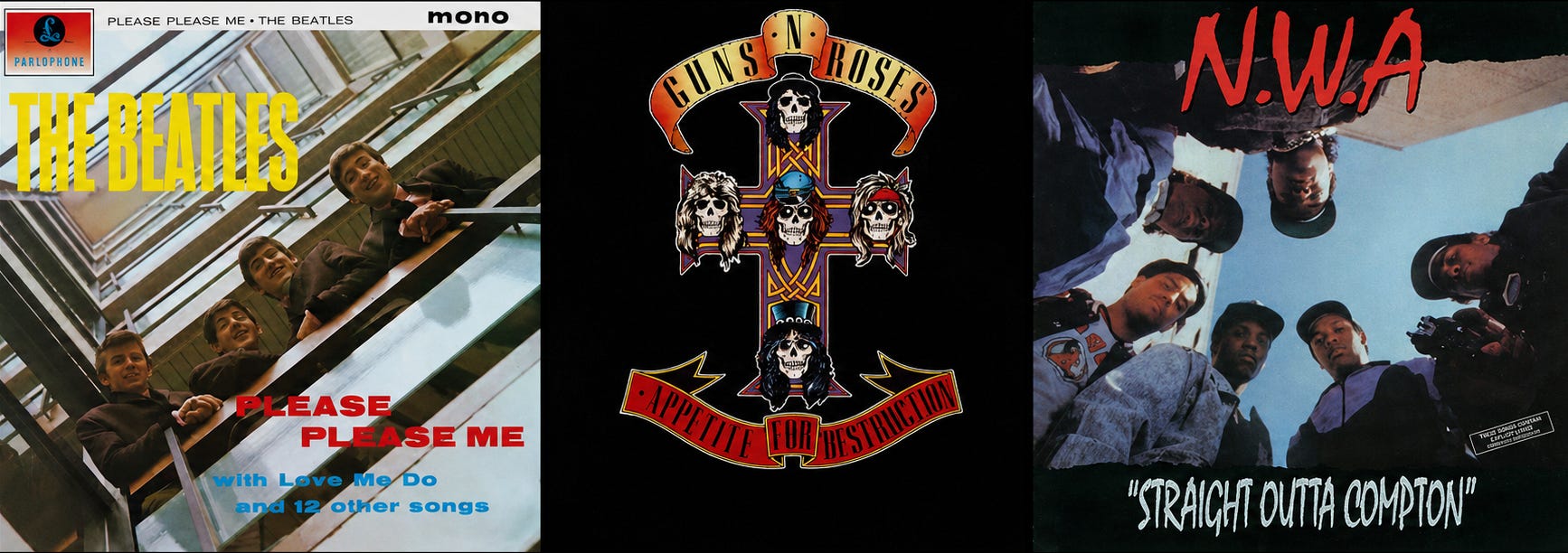
The Declaration is a remarkable document. It’s the original Airing of Grievances - an overlong indictment explaining why it had become impossible for the colonies to trust or abide the British government. It darts from lofty rhetoric about values to alarmist warnings about abuses of power. Which is on-brand, if we’re being honest. As a country, we’d more or less found our voice from day one. In terms of insurrectionary manifestos, the Declaration was Please, Please Me, or Appetite for Destruction or Straight Outta Compton, as your tastes run.
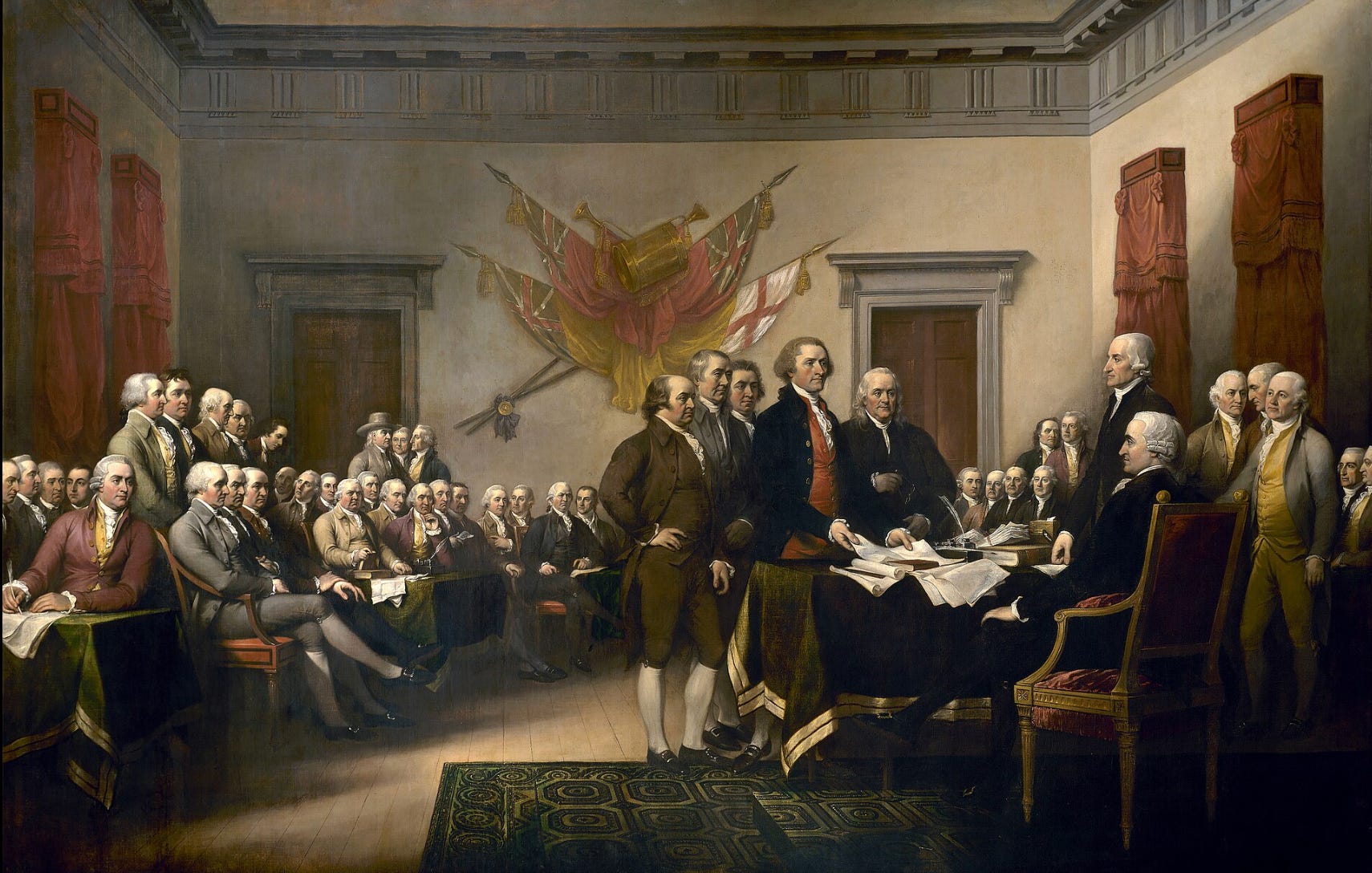
The publication of the Declaration is arguably the moment America became a nation and inarguably one of the most significant events in world history. It’s critical for today’s students to understand its contents and the events it set in motion. But do they? Inquiring minds want to know.
The best place to look is the National Assessment of Educational Progress (NAEP) Civics exam, administered periodically to a representative sample of fourth, eighth, and twelfth graders. It was last given to eighth graders in 2022. Let’s focus on that age group.
I’m going to review:
Three things students DO seem to understand about our founding documents
Three things they do NOT understand
Three things I WISH they understood
Away we go…
✅ Three Things Students DO Understand
(For each item discussed in the next two sections, click the footnote at the end of the paragraph to see the full text of the question.)
We’re starting with the good news. Though it’s true our students are not performing academically as well as they did in the past, they know some stuff that we should acknowledge and celebrate:
They understand individual rights and freedoms. One of the NAEP Civics questions starts with a quote from ACLU co-founder Roger Baldwin: “So long as we have enough people in this country willing to fight for their rights, we’ll be called a democracy.” Eighty-two percent of eighth graders correctly identified the central idea that citizens must actively protect their freedoms for democratic government to thrive. That’s encouraging. The Declaration itself rests on the premise that people possess rights and that governments exist to secure them.1
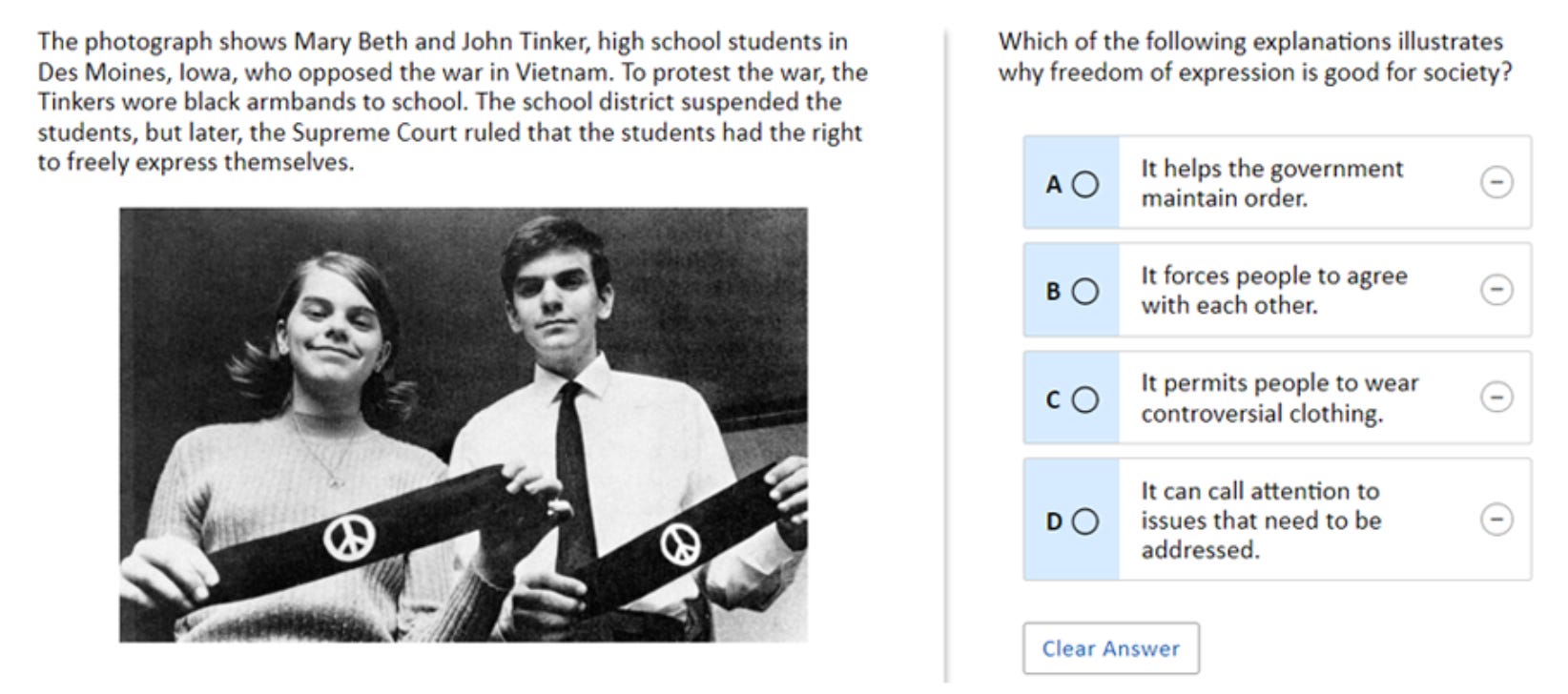
They understand the importance of protecting free expression. In another released item, students were asked about the Supreme Court’s Tinker v. Des Moines decision, in which 1960s high school students wore black armbands to protest the Vietnam War. Nearly seven in ten eighth graders correctly recognized that freedom to take such actions benefits society because they can bring attention to problems that need to be addressed. Good job, kids. The Declaration itself was an act of political dissent. 2
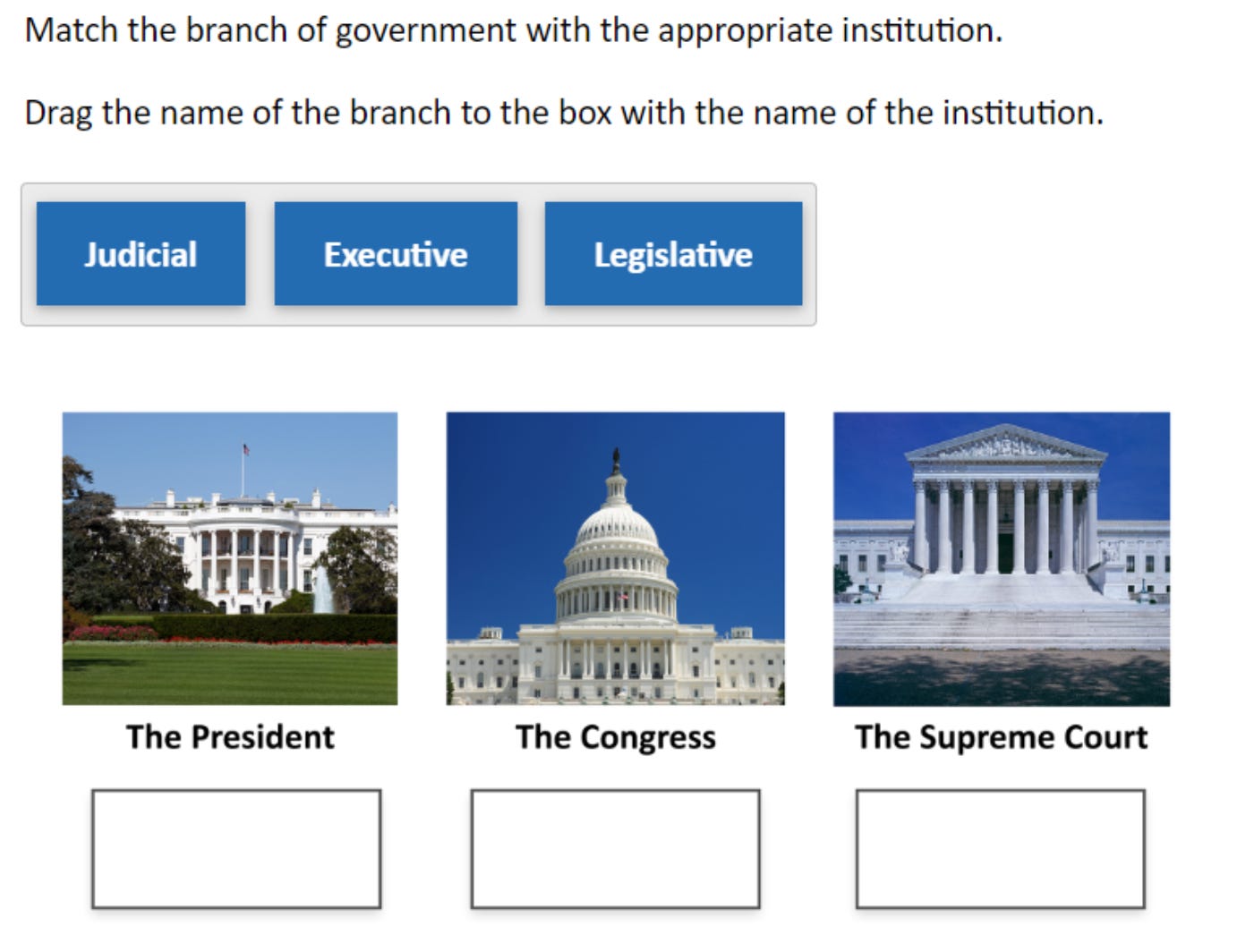
They understand there are three branches of government. Students often struggle with the details of our constitutional design, as we’ll discuss in a moment. But when asked to match the President, Congress, and the Supreme Court with the executive, legislative, and judicial branches, 57 percent answered correctly. Yes, that number should be higher. However, most know there are multiple branches and power is divided. It’s a mini-win.3
❌ Three Things Students Should Understand - But Don’t
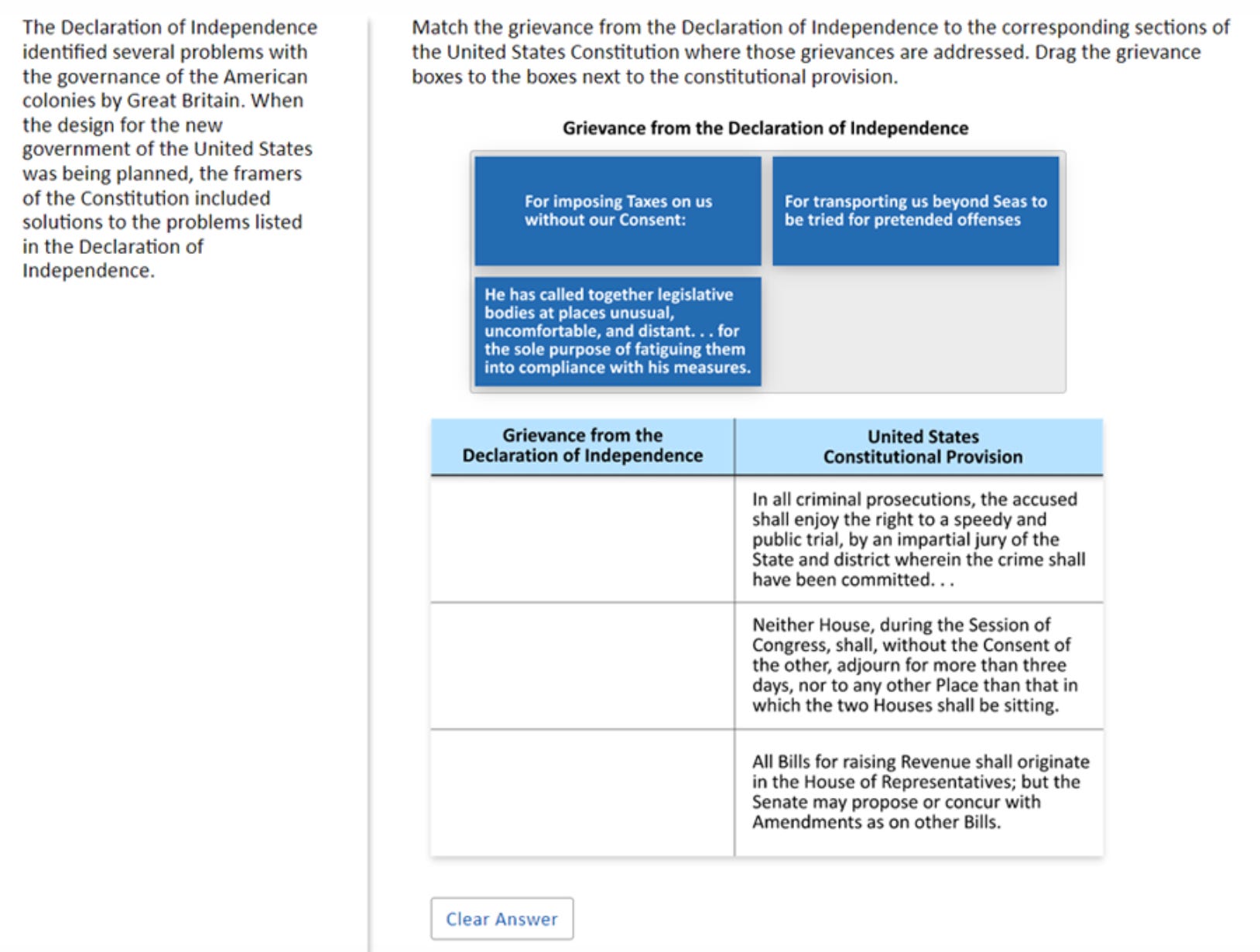
They don’t understand the essential connections between the Declaration and the Constitution. NAEP Civics gave three examples of Declaration complaints and asked students to match them to the appropriate clause of the Constitution where they were addressed. Just forty-two percent of eighth graders correctly connected all three, which included concepts like taxation without representation. This lack of awareness matters because the Constitution was a response to legit concerns about unaccountable power. Students who do not recognize how our government has been designed to solve particular problems may not see the proper role of institutions like Congress, the courts, or elections.4
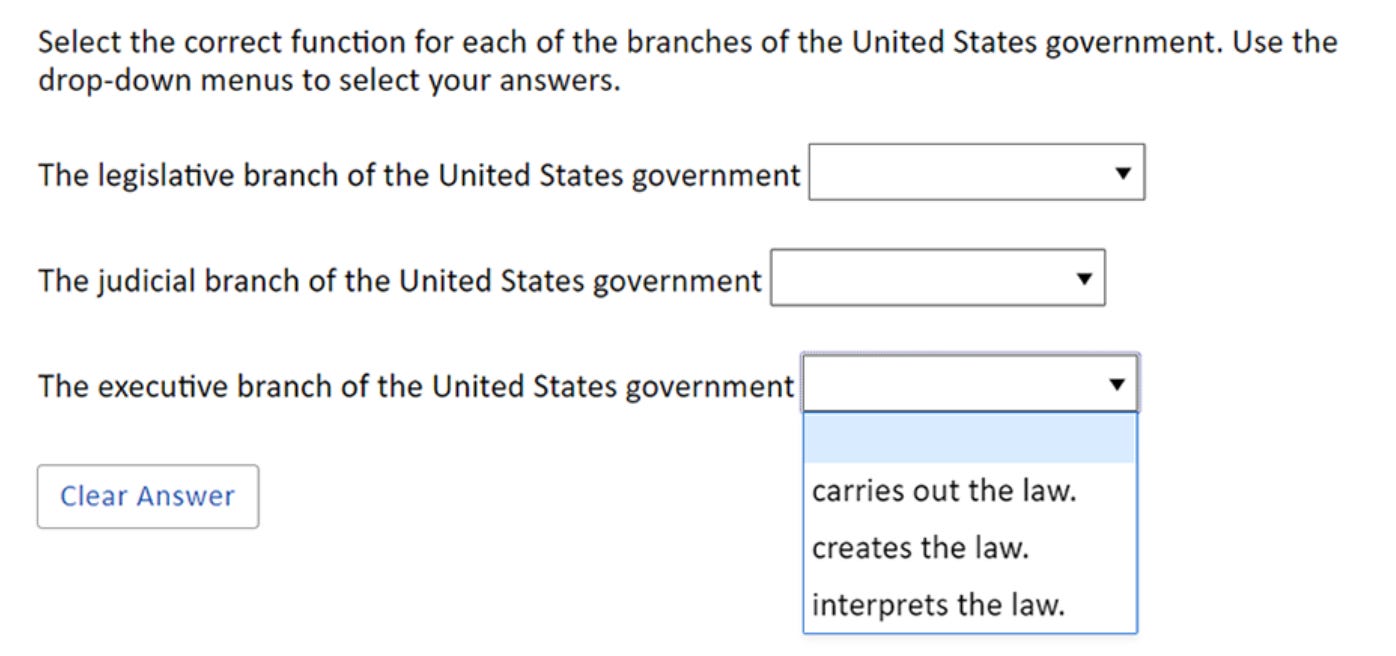
They don’t understand what the branches of government do. Shown the names of the legislative, judicial, and executive branches, only 34 percent of students correctly indicated which one carries out the law, creates the law, and interprets the law. That’s classic Schoolhouse Rock stuff! The founders divided government into branches because they feared concentrated power. This concept is essential for understanding how we function to this day.5
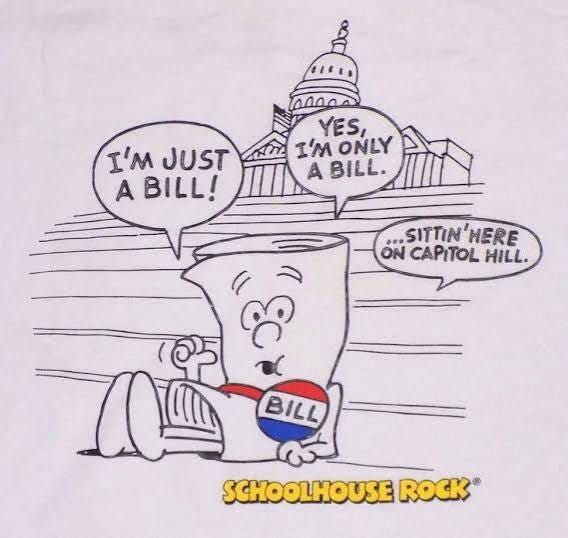
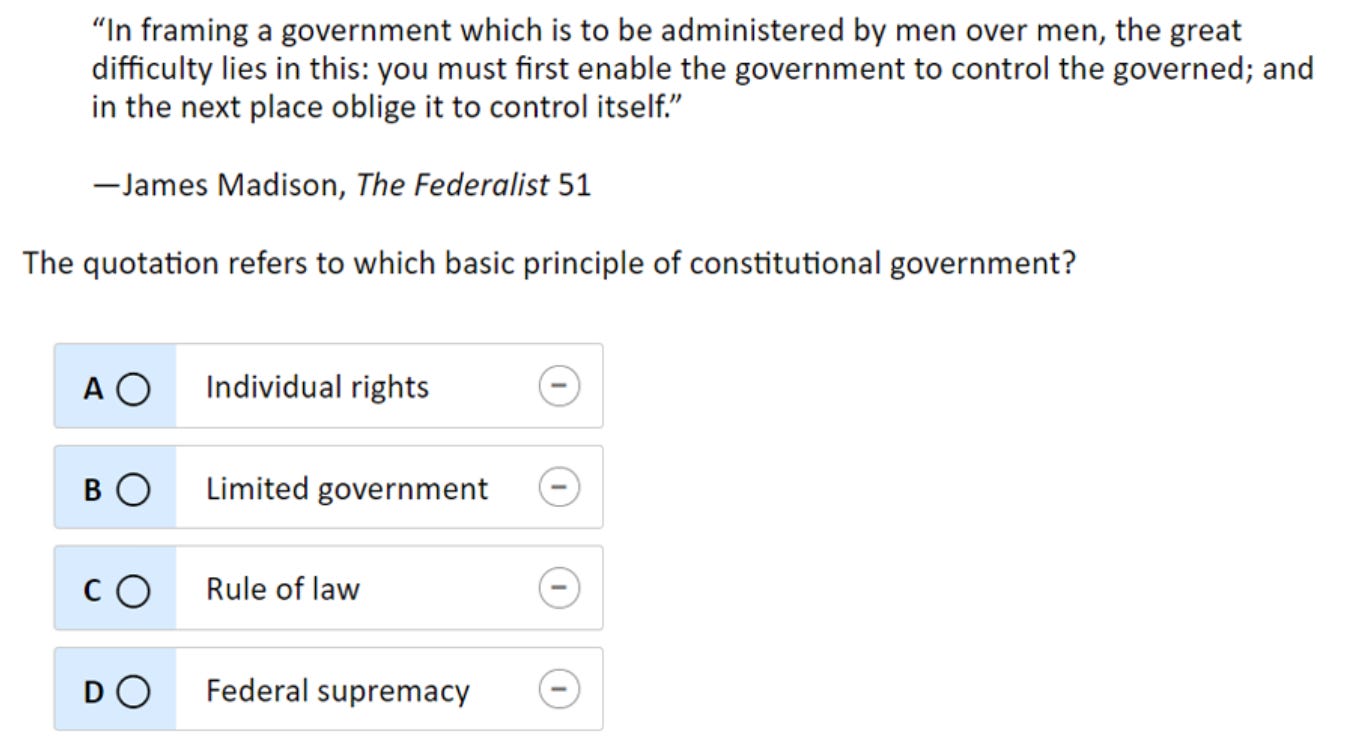
If the song is in your head, you won’t be able to get it out all day and you are definitely Gen X, congratulations. They struggle to identify foundational trade-offs. Provided a quote from Federalist No. 51 by James Madison - “In framing a government which is to be administered by men over men, the great difficulty lies in this: you must first enable the government to control the governed; and in the next place oblige it to control itself” - 41 percent correctly answered that it referred to limited government. The rest chose individual rights, rule of law, or federal supremacy. This is worrisome because a central idea in our Constitution is that the government must be powerful enough to keep order, yet limited enough to remain accountable.6

🙏 Three Things I Wish Students Understood
So far, a mixed bag. To be expected. But in addition to NAEP content, there are things every eighth grader should know about our founding documents, at least according to this former middle school social studies teacher. Given the opportunity, Mr. Daly would have bored the class senseless with the following:
July 4, 1776 was a moment of profound uncertainty and confusion. It’s a made-up birthday, for starters. The Continental Congress actually voted for independence on July 2. John Adams believed that’s the date that would forever be celebrated. While the draft of the public-facing Declaration was approved on July 4, just two individuals - John Hancock and Charles Thompson, who served as president and secretary of the Second Continental Congress, respectively - signed it at the time. Most of the signatures we’ve seen on the document were added weeks later - after initial publication. It wasn’t even clear what our country’s name would be. The word “united” appeared in lowercase, as in “united States of America.” We could have been the “States of America” which happened to be feeling “united.” Other documents during the Revolution referred to us as the United Colonies or even Columbia - hence our capital’s subsequent designation as the District of Columbia. Beyond dumping Britain, we still had a lot of stuff to figure out. Many colonial leaders were understandably terrified.

The Declaration was an angry kiss-off. It wasn’t a law or a sacred text carved into tablets and carried down a mountain. It was never ratified by the colonies. It publicly dared the Crown to do something about our defiance - and invited Britain’s enemies, like France, to give us a call sometime, we’d love to talk. The job of forming a functional government fell to the Constitution, not ratified until thirteen years later, following a nearly failed Revolutionary War and fully failed initial framework called the Articles of Confederation. We learned from our mistakes. We experimented. We amended. That’s how this thing works.
The message of the Declaration changed over time. Later generations interpreted it more broadly than its authors likely intended. For instance, when the Declaration said “all men are created equal,” it meant equal across nations. The people of the colonies were equal to those of Britain, collectively. Then, as historian Garry Wills laid out in a Pulitzer-winning book, Lincoln transformed the Declaration through his 1863 Gettysburg Address from a historical justification for independence into our nation's defining statement of purpose. Recall that in the speech we memorized in elementary school, Lincoln never mentions the Constitution. Instead, he begins “Four score and seven years ago…,” meaning 1776. Gettysburg effectively "re-founded" America around equality. For students, this means that even the most important documents - as well as people and events - do not have fixed meanings. They acquire new dimensions as later generations freshly re-process them. Today’s students have the next turn. It’s a republic, if they can keep it.

All things considered, I’m optimistic.
Today’s eighth graders have some basics. They understand that people have rights. They understand that free expression matters. They understand, at least in broad strokes, that power in our country is intentionally divided.
They are still learning that democracy cannot survive on ideals. It requires institutions, trade-offs, and regular reinvigoration.
The Declaration was never meant to be the last word. It was our first word, in fact. Every generation since has built on it. That’s the remarkable thing about a democracy living to 250. The founding documents may yellow, but the conversation they started remains as fresh as ever.
And now, with class dismissed, let us celebrate this sacred holiday in the manner of our forefathers, by purchasing quantities of poorly regulated explosives from sketchy roadside stands and igniting them in proximity to our children.
Let. Freedom. Ring.
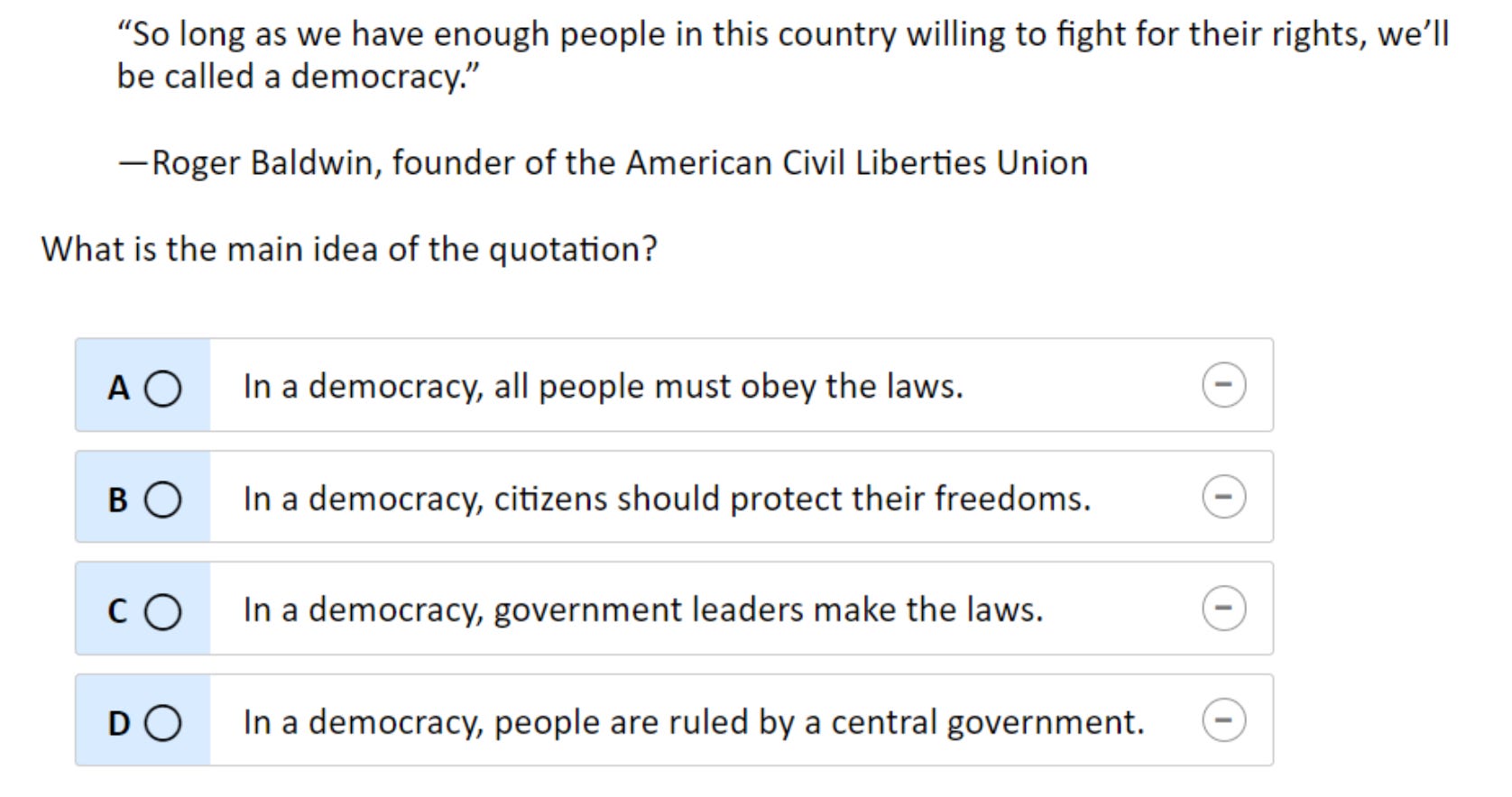
I think you may be overstating the degree of "civics" knowledge that 8th graders possess, based on the NAEP. The first two civics questions seem more like reading comprehension questions to me -- or even just common sense. The first one more or less gives away the answer in the quote itself. And it wouldn't make sense to say that freedom of expression "forces people to agree with each other."
In any event, I don't think familiarity with the nation's founding documents has much to do with getting the right answer to either of those.
"They don’t understand what the branches of government do." I agree that students do not understand this. But their lived reality would make it hard for them to understand. Congress is a shell of itself, the executive branch claims more and more power, and the judiciary supports the power grab. Our branches of government don't even understand what they are supposed to do.