

Imagine a crusader - a seasoned superintendent named to run a major urban system. The sort of leader whose gravitas commands the attention of mayors, philanthropists, and business leaders.
But behind the scenes, all manner of shady stuff.
Before taking the job, the superintendent made a secret deal with a consulting firm. If the business received future contracts from the district, the superintendent would get ten percent of the gross revenue. Not immediately, of course. Paper sacks of cash are bush league. Do try to keep up.
No, the money would be parked in accounts tied to relatives until the superintendent left office, when it could be laundered as a “signing bonus” for a new job that was also part of the package.
The superintendent went to work. First, an announcement for a splashy new idea. Local foundations stepped up to fund a pilot. District staff were directed to find more money to expand the initiative. The favored company was given privileged information about the procurement process. When bidding concluded, the firm won—first to the tune of a few million dollars, then much more.
Altogether, the dirty company would receive more than $23 million in business. The feds began investigating when they noticed money flowing through shell accounts.
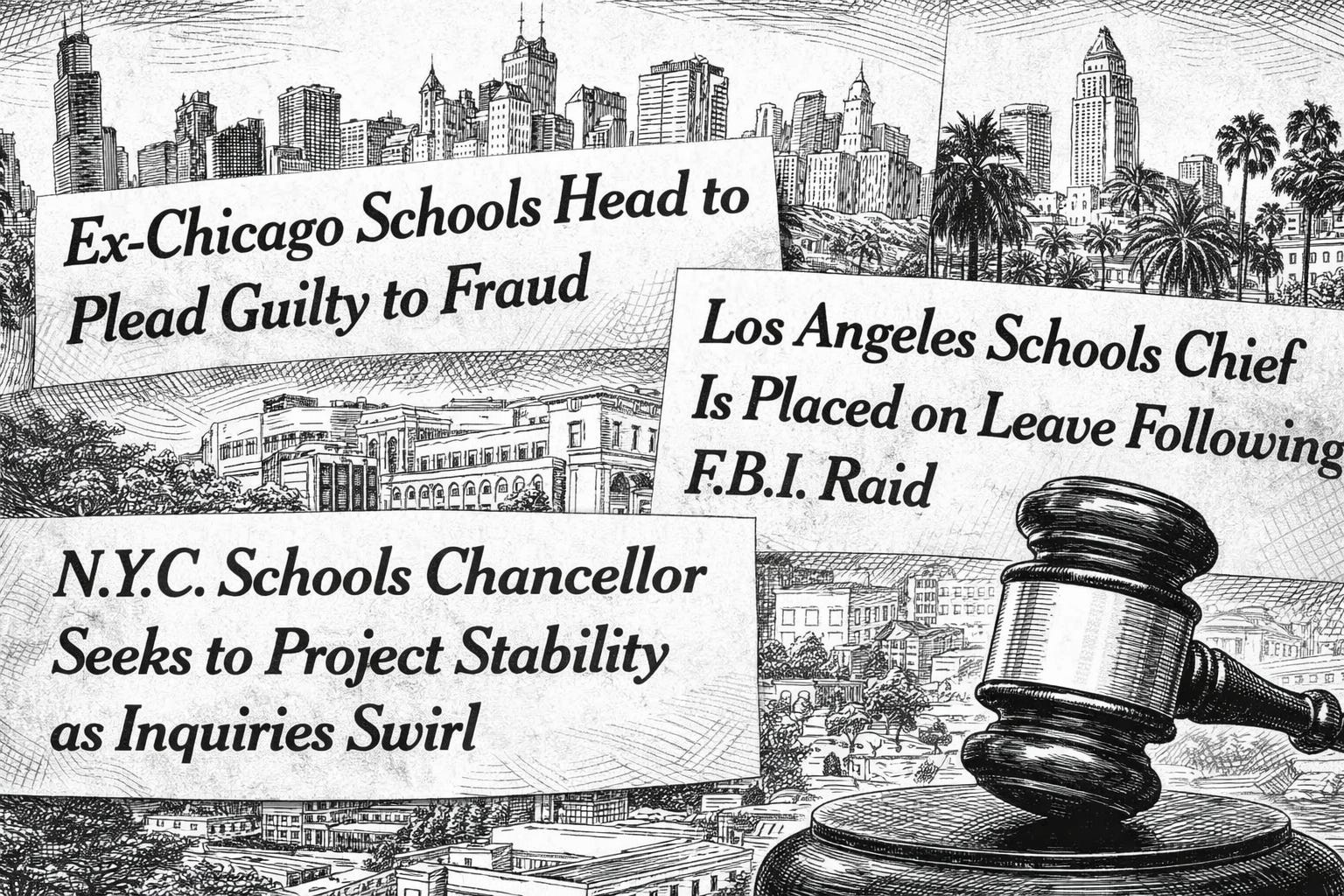
This is the story of Barbara Byrd-Bennett, former CEO of Chicago Public Schools. She admitted all of the above in a plea deal after being arrested and charged with fraud in 2015. She got 4.5 years in federal prison.1
L.A. and New York are the only districts larger than Chicago. Leaders in both cities have been subject to federal raids in recent years. Alberto Carvalho is currently on leave as superintendent of Los Angeles Unified School District (LAUSD) after a visit from FBI agents to his home and office on February 25. New York’s then Chancellor, David Banks, had his home searched in September 2024, reportedly related to an investigation of his brother’s unregistered lobbying practice.
To be clear, Carvalho and Banks are not the same as Byrd-Bennett. They haven’t been charged, let alone convicted.
But if armed law enforcement officers beset Walmart, Amazon, and Apple headquarters; if their CEOs had to forfeit their electronic devices; if banker boxes of documents filled up black cargo vans, it would attract attention. Shareholders might revolt. We’d have a media meltdown about toxic corporate culture.
No such response has followed raids on our three largest districts, which have combined annual budgets of more than $60 billion. Why?
Here’s the core problem: it’s shockingly easy to steal from schools. A culture of insufficient prevention and oversight leads to far too much corruption - and over time, it metastasizes into indifference about non-financial matters such as poor instruction and student failure.
At the risk of providing a how-to manual for the substantial portion of Education Daly subscribers who are aspiring criminals, we’re going to walk through just how bad this can get.
There are at least four major points of vulnerability for graft:
#1. School Board Members
Board members approve vendor contracts for major expenses like construction, transportation, and insurance. With such influence, a stray hand can find its way into the cookie jar.2
Larry Marshall served on Houston Independent School District’s board from 1997 to 2013. Marshall often met with district vendors. Those vendors subsequently hired his friend, Joyce Moss Clay, as a do-nothing “consultant.” She passed along 75 percent of her earnings to Marshall. Marshall “unrelentlessly” (sic) pressured district officials on behalf of his favored contractors. This went on for more than a decade. While Marshall showed a remarkable facility for evading prosecution, he was sued by a firm that says it was locked out of HISD work for refusing to pay bribes. It won a multi-million dollar judgment against him.
Albert Morrison shows that even a small district can be fleeced for big dollars. After receiving a whopping total of 649 votes, Morrison became a board member for the Madison School District in Michigan, where he somehow squeezed $560,000 in payments from a restoration and construction company between 2014 and 2018. The firm earned $3 million in contracts for a district with fewer than 2,000 students. Morrison spent his kickbacks on vacations and a boat slip in Florida before the FBI came calling. He pled guilty and received 45 months in prison.
If companies pay fat bribes out of pocket and still make money off the resulting contracts, how padded are their bids? And how on earth is nobody noticing?
#2. District Employees
Lax financial controls and excessive trust in longtime employees can make embezzlement a lucrative pastime.
Frank Tassone was the beloved superintendent of Roslyn School District on Long Island. In the early 2000s, he teamed with the district’s business executive, Pamela Gluckin, to steal over $11 million through abuse of the district’s expense and reimbursement systems. With two senior officials cooperating, it was simple to approve fraudulent invoices and payments. A few bucks here and there… and the next thing you know, it’s $11 million.3 A student journalist helped bring them down.
Vera Liddell was the food service director for Harvey School District 152, near Chicago. During the COVID era when federal relief money was flowing, Liddell spent over a million dollars on chicken wings for Harvey’s cafeterias - which felt odd, because wings are not reimbursable under federal guidelines and are almost never served in schools due to bones being a choking hazard. Nuggets only, friends. Respect the nugget. But nobody choked. Liddell diverted the wings when they were delivered and re-sold them for personal profit. How many wings are we talking about? It amounted to something like 250 pounds per student. For quite some time, Chickengate went undetected because there was no process for reconciling what was ordered, delivered, and consumed in Harvey. In the meantime, a single under-supervised employee did loads of damage. She got a nine-year sentence.
#3. District Vendors
All it takes is a few willing allies inside the district to concoct a lasting scheme.
Norman Shy ran a benign-sounding company called Allstate Sales that provided cleaning supplies and other basics to Detroit Public Schools. District principals were empowered to select vendors from an approved list. It was their job to certify that purchased goods were received. In exchange for kickbacks from Shy, some principals signed off on invoices for items that were never delivered. From 2002 to 2014, Shy skimmed $2.7 million through fraudulent billing while paying out $900,000 to at least 13 district personnel. One enthusiastic principal received $324,000 for her end. She and Shy were sentenced to multiple years in federal prison.
#4. Union Leaders
Unions blast districts for ineptitude when scandals strike, but they have plenty of their own problems.
Barbara Bullock turned the Washington Teachers Union into an all-purpose fraud juggernaut in the late 90s. It’s difficult to convey the full effort. Over $1 million charged to American Express cards for personal purchases, many of them luxury items. Inflated checks written to her driver - with partial proceeds refunded to her. Union funds paid to shell accounts that Bullock controlled. Unauthorized increases in dues deducted directly from members’ paychecks. Though all of this happened down the street from the American Federation of Teachers headquarters, the parent union took no action until the schemes had been in place for years and the local chapter was virtually bankrupt. The financial damage here was to teachers, not students, but that doesn’t make it less sad.
Let’s Sum Up
What I know: High profile, high dollar school frauds have been a periodic occurrence for decades.
What I suspect but cannot come close to proving: This is a broader problem. Sure, these salacious examples could be outliers. But I worry they are unusual only because the culprits were caught. These people are criminals like Elmer Fudd is a hunter. But what about the grifters who aren’t so greedy? Who cover their financial tracks with a little care? Who know when to step away? How many districts have a hole in the bottom of their financial bucket that nobody has discovered? With local journalism decimated, who’s even watching?

What I definitely do NOT know: How to stop it.
The vast majority of educators are ethical and underpaid. In the service of thwarting bad behavior, we could wrap districts in regrettable layers of red tape that repel talent. That’s a real danger. It’s hard enough to get capable leaders to accept the long hours and grief that come with running a major urban district. Sending auditors to crawl up their backsides won’t improve matters.
But we cannot have federal agents visiting district offices so often they know the front desk secretaries by name. Are there practices we can borrow from other sectors?
Yes, there are. This whole thing hinges on prevention. After-the-fact enforcement is largely ineffectual and unaffordable. Education is too decentralized. We have thousands of districts, most of them with just a handful of schools.
How does strong prevention work? The Government Accountability Office (GAO) has a detailed framework for internal controls. It focuses on preventing fraud by anticipating it - by treating it as expected. Most school systems have not operated this way. It’s all about trust and tradition. We love the kids! We are shocked - just shocked! - each time someone steals from them.
GAO says:
Map where fraud is most likely to happen. Where can money be diverted? Who has access? If you don’t know, you are a mark.4
Segregate duties so one corrupt person can’t select a vendor and also approve a purchase order.5
Do not rely on invoices. Verify that work actually happened and goods were received.
Use data to catch patterns. It’s becoming much cheaper to do this with AI. Scan for invoices just under certain thresholds or vendors sharing the same mailing address - for a start.
Force bookkeepers to take vacations. When they step away, others must operate their systems - and are likely to spot malfeasance if it exists. The selfless, workaholic finance employee is a stock figure in the fraud oeuvre.
Keep an eye on the bosses. “Management override” is apparently a trigger word for veteran investigators. Crusading leaders who demand instant momentum create the conditions for theft. That was Barbara Byrd-Bennett’s signature move.
We don’t need rigidity. It will tie the hands of leaders and drive away honest vendors who are unwilling to plod through procurement mazes that already take too long. We need common sense practices that draw attention to the right red flags so generally honest folks are not tempted to break bad.
This Matters
The siphoned dollars make a difference. They could have funded boxes of crayons and class pets and field trips and teacher appreciation lunches.
But the bigger issue is what our school systems become when fraud happens constantly and with impunity. The core focus is no longer learning. Schools become commercial enterprises lacking the moral compass that makes them special. Rot seeps downward from the central office to classrooms.
Recall the famous Atlanta cheating scandal of the 2000s. Teachers held after-school parties to change student responses on state tests. They earned awards for their schools and financial bonuses for their own pockets. Kids were given falsely inflated information about their performance that prevented them from receiving the remedial support they needed. It set them back for years to come.
This happened in 44 different Atlanta schools. That’s what a culture of corruption can do. And it’s what we cannot continue to allow.
Have your own ideas on how we can fix this problem? Add them in the comments. We need all the solutions we can get.
It’s worth slogging through Byrd-Bennett’s full plea agreement to understand the brazenness of her crimes. The timeline of events strongly implies that she came to Chicago intending to steal from day one.
For those interested in school boards, I highly recommend No Adult Left Behind by Ohio State professor Vlad Kogan. It is a comprehensive cataloguing of how boards provide an illusion of democracy.
Hugh Jackman and Allison Janney starred in a film version of the story called Bad Education. I haven’t seen it but Rotten Tomatoes tells us it’s fresh. Someone give us a review in the comments.
Additionally, districts should demand real declarations of conflicts of interest from board members and employees; then make the existence of an undisclosed conflict - with or without related fraud - a significant violation.
Small districts with limited staff/capacity can institute random second-reviews and board spot checks.
Another (more minor) theft I have regularly seen from superintendents is from their paid time off. Typically, the school board chair approves their time off but actually has no idea when they are out. This is coupled with the fact that superintendents often have a huge amount of paid days off in their contracts that get paid out. I have worked with quite a few who never took a single day off despite regularly being on vacation. They argued they were still on call by nature of their role. but that was unallowable behavior by other senior leaders or principals. This often led to annual payouts of well over $25k.
You remind me that I need to finish a piece on Lies, Damned Lies, and K-12 "Evidence," with a subtitle "Why it's so easy for marketers to scam schools" or "A field guide to scamming schools with faux studies." Because in truth, I think the overwhelming majority of the waste in education comes via the totally legal legal acts of marketing crap to districts, and districts choosing to purchase it. (Hello, national outcry about iReady and other Ed Tech). That said, I appreciate your points here, and we should talk about all of it.