


One Friday in December 2023, Indiana University scheduled a paint-by-numbers press conference to introduce Curt Cignetti as the 30th head coach of its football team, which had distinguished itself over the previous 136 seasons by losing more games than any program in the history of the sport.
Such affairs obligate new hires to recite pablum that no one takes seriously, such as:
“I’m humbled and honored to lead this storied program.” (No bigger name would accept the job at this basketball school.)
“We’re going to do things the right way.” (We will take solace in moral victories and never beat ranked teams.)
“We respect the great programs in our conference.” (I am terrified the big dogs will run up the score on us. Please have mercy.)

Cignetti, an accountant-looking fellow whose personality has been compared unfavorably to tree bark, strode to the podium in a boxy department store suit and promptly blew everyone’s mind.
How, a snide reporter asked, could you possibly sell this program to recruits?
His response: “It’s pretty simple. I win. Google me.”
The reporters regarded the tops of their shoes in disbelief. What’s wrong with this guy?
Later that evening, as I imagine university trustees were exchanging texts searching for a loophole to wiggle out of the hire, Indiana trotted Cignetti onto the court at halftime of a basketball game against Maryland. Before 17,000 rabid hoops fans who likely had no idea who he was, he expanded on his intentions.
"I’ve never taken a backseat to anybody and don’t plan on starting now. Purdue sucks, but so does Michigan and Ohio State.”
Sucks? It’s one thing to say your in-state rival sucks. But antagonizing Ohio State and Michigan? Michigan had just beaten Indiana 52-7. It was a recipe for humiliation.
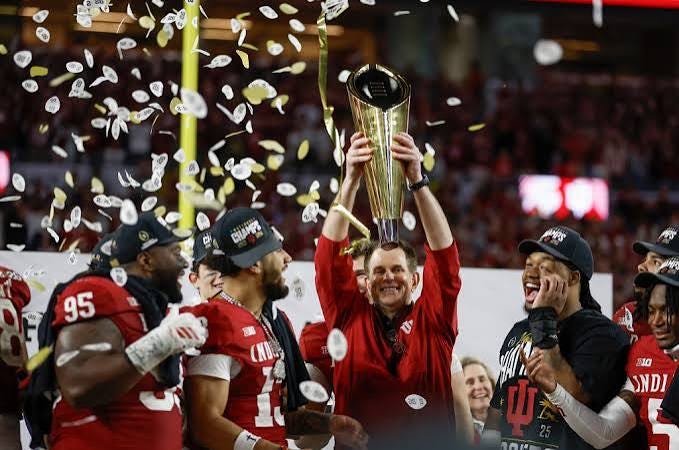
Instead, two seasons later, Indiana went 16-0 and won the national championship.1
We have a little Indiana football in our education game
It was difficult not to think of Coach Cignetti this fall when the United States received another round of tepid international reading results, summed up by the following New York Times headline:

Responses, as per tradition, broke in two directions. Option #1, panic. These folks say we’re facing a crisis, that this is morally unacceptable, that someone needs to DO something, and they need to do it FIVE MINUTES AGO.2
Option #2, long championed by historian Diane Ravitch, is dismissal. This group says the U.S. has never led world performance rankings and it hasn’t harmed our economic development or cultural dynamism, so who cares? “Let others have the higher test scores,” Ravitch wrote back in 2013.3
While we have boatloads of panic and dismissal, we never seem to have a goal or a plan. I mean that literally. The Center on Reinventing Public Education recently found 11 states with no statewide learning goals whatsoever. Only 13 had data-driven, time-bound goals that had been communicated publicly. How can we possibly hold our leaders accountable under these circumstances?4
Which more or less makes us the Indiana of the education world, pre-Cignetti. Somewhere along the way, we stopped believing in our schools, accepting our status as contented losers who can’t imagine being anything else.
It’s a shame, because we could be winners. For real. Despite the scary headlines, the United States ranks 10th out of 83 countries in reading on the PISA test. That doesn’t sound hopeless, does it? Our average score, 490, is 45 points behind the top country, Singapore. For reference, Japan improved by 40 points in just six years from 2006 to 2012. It’s not impossible for us to surpass Singapore within a generation.
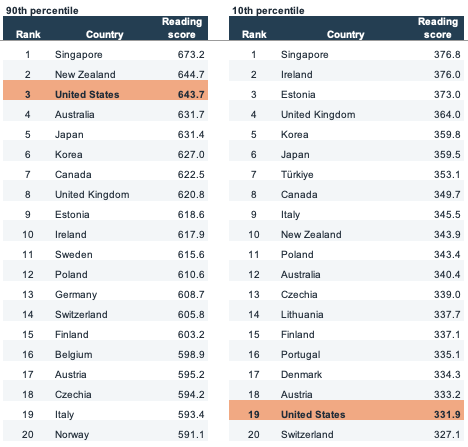
But beneath our solid overall performance, we have a gigantic problem. The gap between our top students (90th percentile) and our lowest-scoring students (10th percentile) is the largest in the world. As the tables below show, our 90th percentile students rank 3rd, behind only Singapore and New Zealand, while our 10th percentile students rank 19th. We have a very high ceiling and a relatively low floor.
This isn’t really about test scores. If the United States committed to becoming the highest-performing country in adolescent literacy, we couldn’t do it without improving outcomes for our most struggling students, which would improve their quality of life remarkably. Good readers are less likely to live in poverty or be victims of crimes. Becoming number one would be transformational for countless families and communities.
We’ve done this before
You think I’m out of my mind, don’t you? That our educational challenges are too deeply engrained and too bound up with other problems like poverty for us to overcome them.
But let me remind you, friends, that we are America. We’ve done this before. Lots of times, actually. Here are some fields where we started out far behind peers only to become the leader:
High school completion. In 1910, only about 9 percent of American kids graduated high school. By 1940, it was 50 percent, higher than any country in Europe and setting a benchmark that the United Kingdom would not reach until 1975.
Scientific research. Once upon a time, Germany had the most advanced university system and produced the most Nobel Prize winners. But once America began competing - by recruiting heavy hitters like Albert Einstein to our shores, for example - the U.S. dominated the Nobel process from 1934-69.
Manufacturing. Britain started the Industrial Revolution. America finished it, growing from about 7 percent of global industrial output in 1860 to 32 percent in 1913, more than twice Britain’s share. It took until 2010 for China, a country with 4x our population, to surpass us.5
Car production. In 1903, America produced a wimpy total of 11,000 automobiles. France - yes, France - built three times that number. I know. Then we got serious. Henry Ford introduced the assembly line. By 1913, we were rolling out 485,000 vehicles, lapping the rest of the world. Over 100 years later, only China makes more cars than we do.
Once we commit, we win. This remains true in the present day. In the past few decades, we chased down Japan in semiconductors and overtook Russia in oil production and out-launched China in satellites.
We win. Google us. 🇺🇸
How to become number one
Nine countries rank ahead of us in reading: Singapore, Japan, South Korea, Ireland, Estonia, New Zealand, the United Kingdom, Canada, and Australia. We won’t surpass them until we’re willing to openly embrace the goal of being the world leader. Enough of this knee-knocking.
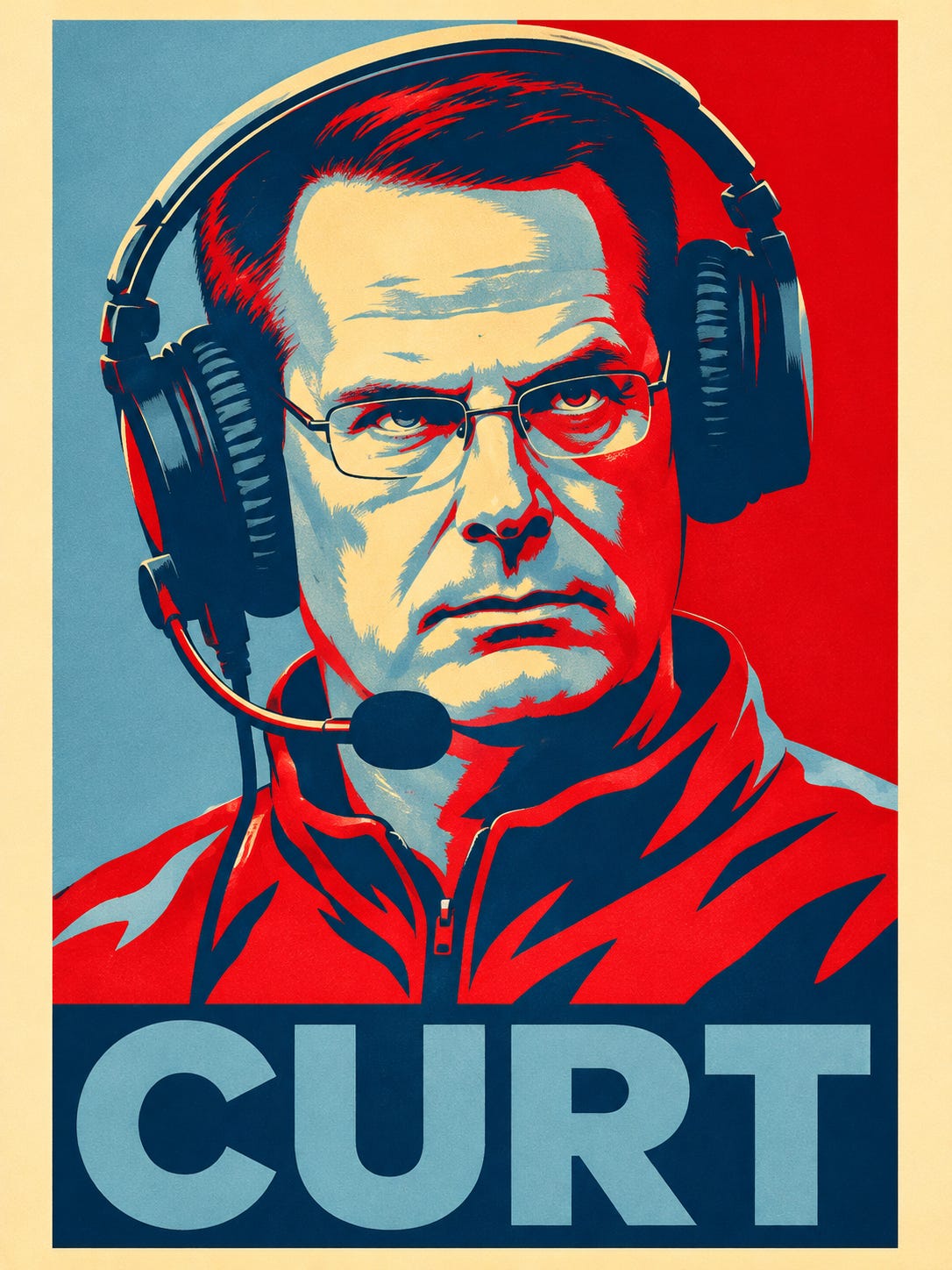
Who’s our Curt Cignetti? Ideally, it would be the President. But President Trump has had no serious interest in improving K-12 performance during either of his terms, nor did President Biden in his single term.
For now, we must look to the governors. Which is fine - we will have 21 new ones taking office in 2027. They are uniquely positioned to drive progress on education. Back in 1989, 49 of 50 governors convened in Charlottesville, Virginia, for an education summit that kicked off a sustained period of achievement growth.6
We should do that again. Get the governors together. Each state can set its own reading goal, but those goals should add up to one thing: The U.S. tops the world in PISA within 15 years. Invite Coach Cignetti to brush off his boxy suit and give the opening address. I’m pretty sure he thinks Singapore sucks.
A goal would give us the framework to inform decisions. How much do reading results need to improve? Which students need the most help? Each governor should appoint someone to be responsible for the plan, put money behind it, and publish an honest accounting of where things stand each year. Fifteen years spans several administrations - which is the point.
Now, what needs to be in each state’s plan?
Leave nothing to chance. To reach the top, we need to raise our floor. That means investing in literacy from birth, particularly for lower-income families whose children too often miss out on high-quality pre-K.
Buckle up, leaders. The science of reading ain’t easy. Ask Mississippi. It takes years to improve instruction before test scores move assertively in the right direction. During that period, decision-makers must hold their nerve. A key moment is approaching this winter, when new NAEP results come out. Based on state-level scores in 2025 and 2026, I am not expecting a big jump in reading. That doesn’t mean the dozens of literacy laws passed in recent years aren’t working. It means we need to keep grinding.
Get serious about teen reading. PISA surveys show students who read habitually at school and home also perform better on the test. Adults play a key role in modeling reading themselves and asking students about school.7 To date, we’ve waved the white flag to tech.
Embrace competition. The U.S. is competing with the other developed nations. California is competing with Texas. And we’re all competing with failure. That’s the reality. Let’s understand our weaknesses, address them, and put some wins on the board. Enough of this nonsense that “our kids don’t test well.” That’s like Indiana saying “we only play well against Ball State.”
Invest endlessly in boring execution. This is another lesson from Coach Cignetti. While he projected bravado externally, he actually ran his program with relentless internal attention to preparation and execution. Nothing fancy. He ignored recruit rankings and focused on adding transfer players who’d already been successful at the college level - even if they had been at lower levels of competition. That’s how reading instruction works. It’s a fistful of small moves repeated consistently by teachers who know what to look for and how to address challenges. And those teachers set a high bar for their students.
America won’t become the top nation for literacy through bluster alone. But we won’t accomplish anything at all until we believe in ourselves and our kids. That’s what Cignetti understood about changing the football culture at Indiana, and it’s why his mouth wrote a bunch of checks his butt wasn’t quite ready to cash. He knew exactly what he was doing.
At the national level, we aren’t competing for a ranking. We’re trying to give our young people the best lives possible. Reading is the key. If our leaders don’t understand that, we need to get some new ones.
If you don’t follow college football, this was not a one-hit wonder. Indiana is 8-1 so far this season and on its way to a third consecutive appearance in the national playoffs.
Examples include the chair of the House Education and Workforce Committee, Tim Walberg and the Bipartisan Policy Center.
Ravitch isn’t alone. Others in the dismissal camp include Richard Rothstein, who wrote in 1999 that “We shouldn’t want first place even if we could have it.”
Kevin Huffman has a great reflection on the dynamics of goal-setting for state leaders.
Despite surrendering the manufacturing crown, the U.S. maintains a gigantic advantage over China in per capita GDP.
Look to Figure A, page 3, in this summary of trends through 2012.
Details available in this report.
Process and focus matter, and small wins build belief. Belief builds reinvestment in process and focus which reinforces the whole cycle. But - you have to start by agreeing that winning games is important, and that losing to other countries is bad. If we can't agree on that, then it's easier to just base policy on whether the players on the field are having fun.
A stirring pep talk and for sure we cannot resign ourselves to the idea that what we perceive as problems are somehow intractable, because otherwise, what are we here for?
Cignetti is no doubt an excellent football coach, but there is a far more important person when it comes to the success of the Indiana football team, University President Pamela Whitten, who made an affirmative decision to try to bring Indiana up to the level of other Big 10 schools when it came to football.
The mechanism was money, lots and lots of money. Indiana went from one of the lowest spending teams to one of the highest within a few years. Cignetti, with his war chest, hit the portal, including buying up Fernando Mendoza for double (or more) than what he was making at Cal. Cignetti was a first mover on the new model, essentially put all of your eggs in buying up established free agents instead of recruiting 18 year old possible superstars and waiting for them blossom (or not).
This has created a virtuous circle where the team's success continues to bring in more money because people see a winner and want to be part of it.
But there's some lurking issues to this success we also must consider.
While Indiana reports a surplus in its athletic department budget, this is only because in their championship season they had a nearly $30 million subsidy from the university. $30 million that was taken away from academic operations to support athletics. This is the third highest subsidy in the Big 10, behind Rutgers (which has a nearly $50 million structural deficit) and UCLA.
Is this truly sustainable? What happens when Indiana has a non-playoff season? They're currently ranked 4th, but have had two incredibly close calls in games. If both of those games had gone the other way they'd be on the outside looking in. Also, now that other programs are copying Cignetti's approach to the portal, his ability to land difference makers like Mendoza will be much more difficult. His ability as a coach will likely help IU maximize the talent has, but this being college football, fans will begin to chafe if/when excellent results become merely very good. (Just ask Dabo Swinney.)
We should also note that Pamela Whitten, supposedly the head of an educational institution, has been cracking down on both faculty and student freedoms and speech, including putting state trooper snipers on the roofs of buildings during student protests. She remains very popular with alumni because of the football team's success, but she is turning Indiana University into a football team with a university attached to it.
All of this is to say that when we work from analogies, as you've done here, we should consider the whole story of the origins of these success and what they do and don't mean. Self-belief is great, but Indiana University football is a story about money and investment, and how defining success by one metric (football team wins) may mean sacrificing something else (the spirit of the academic community the institution is meant to serve).
How are you going to guard against these potential downsides with your approach?