


Teen cinema has always laughed at the try-hard.
There’s Tracy Flick (Election), wallpapering the halls with homemade campaign posters. Max Fischer (Rushmore), fencing in his school blazer.1 Hermione Granger (Harry Potter), hand frozen in the raised position. Cady Heron (Mean Girls) proudly joining the Mathletes before learning they are social kryptonite.2

Trying hard was uncool. In the teen code, status should accrue effortlessly to rebels who barely want it. Better to be Ferris Bueller (Ferris Bueller’s Day Off), Cher Horowitz (Clueless), Jeff Spicoli (Fast Times at Ridgemont High) or Ren McCormack (Footloose) — boatloads of charisma, no strain.
The humor landed because the try-hards accepted the standard hopes of adults and then dialed them up so energetically that even the adults found them annoying.
There are fewer try-hards today. Over time, American schools have reduced friction in the name of worthy aims like equity, wellness, and belonging. By friction, I’m talking about the conditions - and reasonable pressures - that make effort necessary, not optional. Some changes were sensible. But collectively, we’ve watered down the notion that it takes effort to succeed - that trying is a key part of a student’s job.
The chain goes something like this:
We demand less
Students rationally do less
Lower effort reduces cognitive engagement
Reduced cognitive engagement drags learning
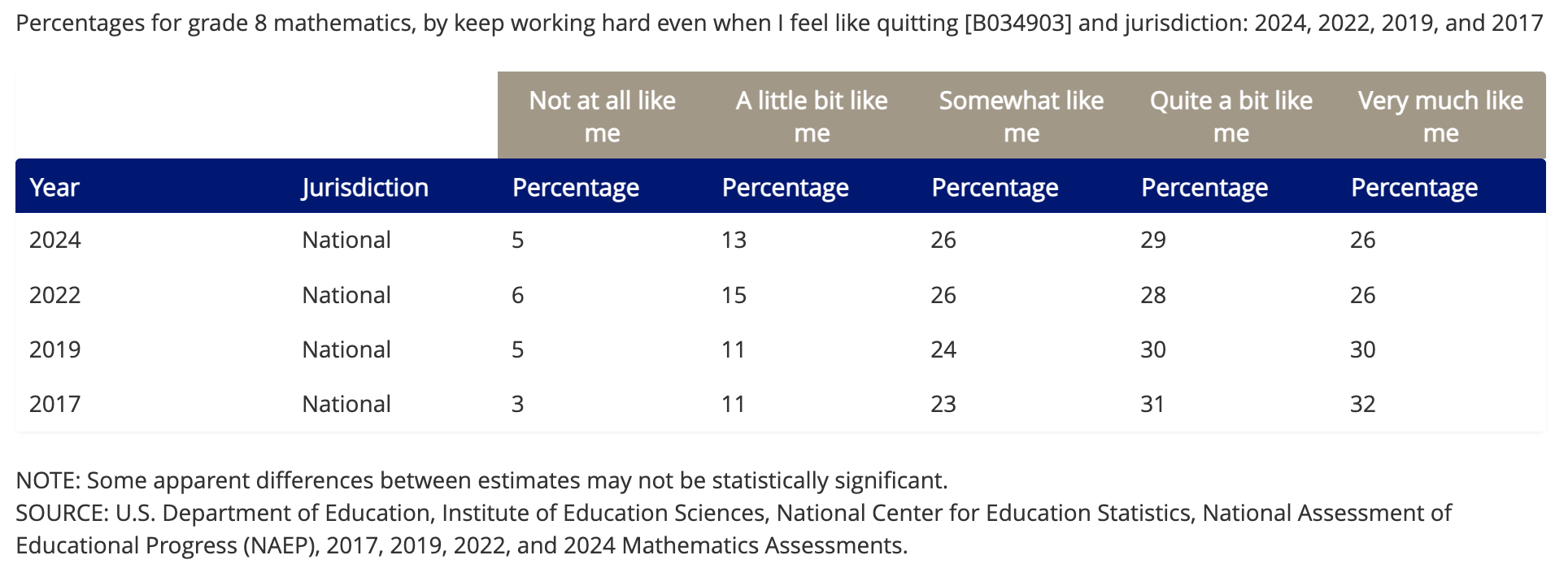
National achievement shows the damage. Since 2017, eighth graders taking NAEP math have been asked about their effort by reacting to the statement “I keep working hard even when I feel like quitting.”
While average math scores have declined for all student groups, those who say the statement is only “A little like me” or “Not at all like me” have lost the most ground - and they are still dropping.3
Ferris is no longer thumbing his nose at the system. The system has become Ferris.

Bye-Bye Friction
Examples of reduced friction include:
Lenient Grading. Grade inflation has accelerated over the past decade and persists despite research suggesting it harms students by reducing their future academic success and earnings.4 It also decreases effort - particularly for struggling students. Some schools go the full Monty, banning zeros for work not completed, removing penalties for late submissions, banning homework, or allowing unlimited test retakes. (Most of these policies are unpopular with teachers.)
State-Sanctioned Absenteeism. The most elemental facet of effort is showing up. Since COVID, we’ve had an epidemic of chronic absenteeism that we cannot seem to fix. On top of that, ten states newly allow students to be absent from school for mental health days. In no way am I suggesting that students suffering with mental health issues be forced to show up when they are unwell or unable. But the laws don’t require any evidence that a student has an issue.5 Kids can just take a day. Or multiple days. Missing school has been broadly normalized - including by policymakers.
Lower Graduation Requirements. One state after another is reporting all-time high graduation rates, which is odd because test scores are down. How is this happening? One factor is credit recovery, a practice that allows students who fail a course to receive credit through alternative processes that do not involve retaking the entire class. It’s almost always much easier than the original course. Some states depend heavily on credit recovery to ensure students can earn diplomas. Then there is the demise of exit exams. In 2012, half of states required students to pass tests to graduate. Today, it’s down to six. That happened fast. So, credits are easier to get and there’s no check for understanding to serve as a backstop. Graduation rates have risen automatically - and will continue to do so.
These shifts send a message to students: We adults will adjust the system before we ask you to adjust your effort.
Even if we don’t intend it, our choices frame trying hard as excessively stressful - even traumatic.
Effort Is Not Traumatic - It Is How Learning Works
The University of Virginia’s Dan Willingham has written for decades about the psychological sausage-making that is learning. My reading of his work, much of it published in the once-great American Educator magazine, suggests:
What we remember depends on what we actually think about.
Unless the cognitive conditions are right, we humans are happy to avoid thinking. Yet, there is a productive level of stress that makes us stronger.
Sustained practice is essential. Otherwise, gains fade.
Summary: Less effort means less learning. Against this backdrop, our decade-long education depression makes sense. Look, I’m not trying to claim that student effort is the only thing that determines academic outcomes. All sorts of things are important, from curricula to field trips to healthy food to good sleep - but can we at least agree that kids trying their best is part of a balanced breakfast?
Do We Value Effort?
Some schools still embrace the try-hard ethic. Eva Moskowitz, founder of Success Academy, is relentless and unapologetic on its behalf. In How the Other Half Learns, Robert Pondiscio describes Success Academy campuses as intensely serious about student focus. Silence and attention are taught explicitly. Transitions are choreographed to avoid lost time. Students are told constantly that effort matters. Discipline is tight.
As a result, Moskowitz is the Tracy Flick of the charter world, treated as a pariah by many educators who find her methods draconian. To some degree, I understand. Success Academy is not everyone’s cup of tea. But let’s not forget that more than 90 percent of its students meet New York state standards in reading and math. Eva’s focus on effort seems to pay off for families who buy in.
Meanwhile, in the broader landscape we’re responding to our era of tech-based distraction by deploying ever more tech-based education platforms, hoping they will be so well engineered that students won’t be able to help themselves from completing all sorts of lessons, thereby solving our learning challenges. Techno-optimist influencers like MrBeast are telling us that “kids could probably learn more in 5 hours than they currently do in 8 hours.”
The track record for this approach is not good and not improving. As just one example, a recent study of Khan Academy found that while 200,000 students had access to its platform, only 20,000 used it for even 30 minutes per week, as recommended. Most were active for fewer than 10 minutes.
Khan Academy declared victory in a confusing and meandering statement. But rolling out a learning tool that goes largely unused is a failure. It’s like opening a film on thousands of screens and grossing only a few million dollars. It’s Gigli.

I’m worried that we’ve lost the plot a little bit. What matters is not what cool things tech might do under perfect conditions. What matters is whether kids think. Can we still distinguish between those things?
What makes kids try harder?
Teachers, mostly. Strong teachers motivate students to elevate their effort as the material gets more challenging. A positive school culture - the sum of many teachers and support staff aligned to the same standard - ensures consistency across classrooms and magnifies the effect.
The Gates Foundation’s Measures of Effective Teaching (MET) study showed this pattern by surveying lots of kids. Learning gains were higher in classrooms where students agreed with statements such as:
“My teacher pushes us to think hard about things we read.”
“My teacher pushes everybody to work hard.”
“In this class, my teacher accepts nothing less than our full effort.”
“My teacher doesn’t let people give up when the work gets hard.”
“My teacher asks students to explain more about the answers they give.”
Pushing students isn’t the whole story. In the study, high-performing teachers also ran well-organized classrooms and based lessons around worthy, rich content. But they expected kids to work.6
Want a real-world example? Chad Aldeman just profiled a small Maryland county that’s generating remarkable, sustained improvement in literacy:
Students are expected to complete two 15-minute blocks of reading at school — and then read for 30 additional minutes per day at home. This regimen may vary based on the child’s age and skill level, but kids have to log what they read and then have their teacher or parent sign off.
Families, in fact, are the third key component of Worcester’s reading plan. At the beginning of the school year, they’re asked to sign a “home coach contract” saying that they will check and monitor their child’s reading. Throughout the year, kids are expected to read for half an hour at home five days a week. Over the course of a 180-day school year, that could add up to 900 extra minutes of practice.
This district missed the memo on reducing friction. In Worcester County, effort reigns.7
The Genie in the Backpack
AI could make our problems profoundly worse. It is a cold, efficient friction-gobbling monster.
For centuries, students were forced to confront the blank page. They often sat with confusion until clarity began to emerge. That struggle, per Prof. Willingham, was the point.
Now a student can spend six seconds tapping out a prompt and receive polished work in return. The lamp is rubbed. The genie grants the wish.
The greatest danger here is not cheating but habituation. Kids may become conditioned to delegate their thinking until they no longer have the stamina for deep learning and understanding. At that stage, what is the point of school?
Let’s recalibrate a bit
I don’t want our schools to be miserable pain factories ruled by stopwatches and hard hearts. Truly. But we have an effort problem. Some would write off our current crisis wholly to screens and social media. But Big Tech can’t wear the jacket alone.
As adults, we create the conditions under which schools operate. We’ve made plenty of choices affecting student engagement that have nothing to do with technology… and they’ve bitten us in the tuchus. There’s room for course correction if we stop apologizing for effort and resume valorizing it.
How? Make effort the rational choice for students.
Name grade inflation as a harmful instructional practice and approach it accordingly. We haven’t done this yet. Grading policies are almost entirely a teacher’s personal decision. But now that we know lenient grading is bad for kids, we need to stop it. We no longer feel it’s acceptable for elementary teachers to ignore phonics. Why would we look the other way if middle school teachers hand out A’s without asking kids to think hard?
Related: Back up teachers who are demanding. School administrators and parents, that means you.
Make retakes cost effort. Before students get a second chance at a test they bombed, require that they submit written corrections for the first test and complete a practice problem set or essay that demonstrates progress toward mastery. Otherwise, the first test is just a free sneak preview that the teacher wastes time grading.8
Treat punctuality and attendance as non-negotiable. Don’t be afraid to issue sensible consequences for students who aren’t showing up, such as letters home, restrictions from school field trips and sports, or requirements to attend summer school to make up what’s been missed.9
Reinstate public recognition of effort. Honor rolls, perfect attendance certificates, 95 percent homework submission awards - these things send a message celebrating important habits and accomplishments.
Make better high school culminating assessments. I’m not wedded to state-administered exit exams. Alternatives include publicly defended senior projects, independently scored course finals, and International Baccalaureate programs. If nothing changes, the value of a high school diploma is going to erode quickly.
Teach effort. Practice it. Eva Moskowitz has her eye on the right ball. Students need to understand how to persist through difficulty, when to ask for help, how to organize themselves to study, and how to distinguish between strenuous thinking and genuine distress.
We laughed at Tracy Flick for being too much. That was our bad, Tracy. We need you back - at least a smidge.
My favorite of Max’s clubs was the Bombardment Society. Perhaps you were partial to the Yankee Racers.
I really wanted to include Brian Johnson (The Breakfast Club) for getting a fake ID so he could vote. But there’s only room on Mt. Rushmore for so many heroes. You are not forgotten, Brian.
Additionally, there are fewer students in the top effort categories than past years. Less effort AND less learning for each level of effort.
Leniency plays a key role in misleading parents, who trust grades much more than test scores.
I can’t find any indication that states are tracking how many mental health days are taken - which would make it impossible to understand the degree to which they are contributing to absenteeism overall. If anyone knows differently, please drop me a line.
David Blazar and Matt Kraft co-authored a really interesting paper showing that teachers who generate gains on measures of self-efficacy, happiness, and behavior in class aren’t always the teachers who generate higher test scores - a reminder that teachers influence students in diverse ways that cannot be easily reduced.
The same pattern is evident in the Department of Defense Education Activity (DoDEA) schools, which we explored in January. It’s what makes DoDEA our country’s best school system.
Some schools don’t even allow students to be eligible for retakes unless they submit a study guide before the first test. No sneak previews. Good idea!
Some organizations that lead fantastic work on absenteeism, such as Attendance Works, are adamant that any punitive measures are counterproductive. I’m not sold - especially in light of the jump in absenteeism since COVID. I’m encouraged by schools like Ponus Ridge STEAM Academy in Connecticut, recently featured in The 74. They offer all the supports - early, supportive intervention; interesting activities like robotics; warm communication; immigration attorneys during the ICE raids. And also: “an email home if a student misses two days in a row, a letter home once a student misses six days, another letter at 12 days, and an email home each day a student is absent if they have missed more than 10 days… For any student who reaches the level of chronically absent –18 absences out of 180 school days – the school sends a referral to the state Department of Children and Families.” That’s how you get “by far the lowest rate of students chronically absent” among Norwalk’s 21 schools.
I agree with everything that you're saying, and I appreciate such a thoughtful, well-written discussion. Thank you! But I think there's an important point that you need to address.
When we make school more demanding, and require more student effort, many students will rise to the challenge. But a non-trivial proportion of students won't; that's just the reality of the world. What will you do with those students? If you are really serious about raising standards, then it's unavoidable that you have to penalize these students. Of course that doesn't mean that you beat them or humiliate them, but it does mean that there have to be negative consequences for non-performance, and that includes failing the student and/or denying them a diploma. Are you prepared to do that? Everybody wants high standards, but nobody seems to acknowledge that enforcing those standards is unpleasant, and that some students will suffer.
Here's a simple thought experiment. Suppose you are the principal of a high-school that has an 85% graduation rate, and you decide to raise expectations and demand more from students. But then when this is implemented the graduation rate drops to 50%. Sure, the kids who survived the newly rigorous standards now are better educated than before, but at the cost of a 50% attrition rate. Are you willing to accept that trade-off? If not, what is the biggest drop in the graduation rate that you would be willing to accept in exchange for your proposals?
Your thoughts reminded me of Nietzsche in "In Human, All Too Human." He writes (paraphrasing) that we speak of genius as though it were a miracle, but what distinguishes the great individual is sustained labor and a certain “economy of means” developed over time.
King made a related observation in his Three Dimensions sermon, that whatever our lot in life, we owe it to ourselves to aspire to be the best at it.
Finally, recall when Cassius tells Brutus: “The fault, dear Brutus, is not in our stars,
But in ourselves, that we are underlings.”
There are many inspiring examples in our history and culture. If we chose to follow them.